41% of CISOs are already accountable for global privacy outcomes
Gartner notes that AI adoption is leading cybersecurity leaders to take on an increasingly important role in privacy.

AI adoption, regulatory developments, and growing data volumes are making privacy increasingly complex. This report analyzes the technologies and capabilities evolving to help organizations protect and manage personal data more effectively and at scale.
→ Download the report and explore the key insights.
Personal data is increasingly distributed across applications, databases, cloud environments, SaaS platforms, and legacy systems. This fragmentation makes it harder to maintain visibility and apply privacy policies consistently, at a time of increasing regulatory pressure and new data uses driven by AI.
Move toward a model that combines privacy management with data-centric controls: discover what personal and sensitive information exists, locate it, understand where it resides, and use that knowledge to apply protection, minimization, retention, or deletion policies.
A stronger ability to translate privacy policies into technical and operational processes, reduce reliance on manual tasks, and manage personal data in a more consistent, traceable, and scalable way.
The report highlights that "technology is not enough to establish a mature privacy program". Organizations need to combine governance, privacy by design, and management processes with capabilities that enable them to understand and act on the data itself.
Identify what information exists and where it is located to gain visibility into data distributed across different systems and repositories.
Use data discovery results to build a clearer view of the location, context, and distribution of data, and identify which information requires protection or further action.
Connect privacy policies with the systems and data they need to be applied to, strengthening consistency and oversight.
Link knowledge of the data to decisions about how long information should be retained, which data is still necessary, and what can be deleted or minimized.
Translate rights requests into actions across the systems where the information resides, enabling access, rectification, blocking, or deletion to be carried out consistently.
Reduce reliance on manual processes for privacy operations that need to be carried out repeatedly and at scale.
Gartner notes that AI adoption is leading cybersecurity leaders to take on an increasingly important role in privacy.
The growth and evolution of privacy regulation are reinforcing the need for programs capable of managing privacy consistently and at scale.
Managing access, rectification, and deletion requests at scale increases the need for visibility into where personal information is located.
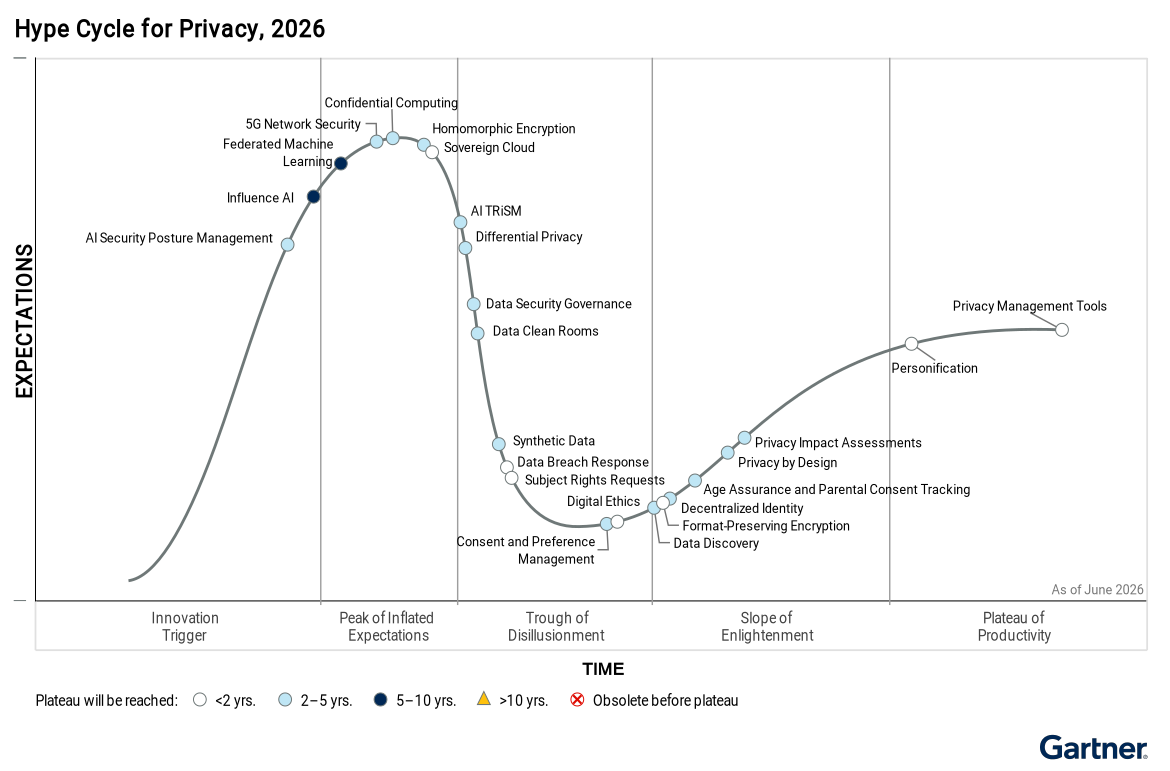
The Gartner® Hype Cycle™ for Privacy, 2026 helps organizations understand which technologies and capabilities are evolving around privacy and the role they can play in building a more scalable privacy strategy.
To prioritize investments, understand which capabilities can strengthen personal data protection, and anticipate emerging risks associated with data fragmentation, regulation, and AI.
To understand which technology capabilities can help translate privacy policies into action at the data level, supporting processes such as data discovery, minimization, retention, and rights management.
To assess which capabilities the technology infrastructure needs to support more consistent privacy management across environments distributed between applications, cloud platforms, SaaS, and legacy systems.
To understand how data discovery, classification, and governance contribute to a broader privacy strategy, and how discovery and governance technologies connect with rights management platforms.
The Gartner® Hype Cycle™ for Privacy, 2026 analyzes the technologies, governance practices, and operational capabilities evolving across the privacy landscape.
The research helps cybersecurity and privacy leaders understand their maturity, assess their potential, and prioritize investments aimed at achieving more scalable protection.
According to our takeaways:
For CISOs, it provides context for identifying technologies and capabilities that may form part of a data protection strategy and help inform investment decisions.
For DPOs and privacy leaders, it provides a perspective on the infrastructure and technical capabilities needed to translate privacy policies into action at the data level.
It can also be relevant for CIOs, CTOs, IT, Security, Data Architecture, and Data Governance teams, as privacy increasingly requires coordination across different functions within the organization.
Gartner notes, “Data discovery helps mitigate data sprawl across hybrid, cloud and SaaS environments.”
Gartner also recommends, “Drive data life cycle management by linking retention, deletion and minimization policies to discovery insights.”
It helps reduce the gap between defining a privacy policy and being able to put it into practice.
When personal information is distributed across multiple applications and repositories, processes such as minimization, deletion, and rights management can depend heavily on manual searches and actions that are difficult to maintain at scale.
Combining privacy management with data-centric controls can help organizations move toward more consistent and operational privacy management.
Organizations are operating in an environment of increasing regulation and increasingly intensive use of data.
Regulations such as the GDPR, Spain’s LOPD, and Chile’s Law No. 21,719 are leading many companies to review how they translate privacy obligations into real technical and operational processes.
Having visibility into what personal data exists and where it is located provides a starting point for applying the appropriate policies and controls.
Based on our interpretation, it refers to a vendor identified by Gartner as an example. It should not be interpreted as a ranking or recommendation, but as a reference point within the market analysis.