84% are increasing GenAI investment
"84% of respondents state that their enterprise is increasing funding for generative AI (GenAI) in 2026, signaling a surge in artificial intelligence (AI) investment across human and social services."

This new report explores the modernization of social services and showcases the technologies making it possible. Among them, DevOps Test Data Management, whose purpose is to safeguard software quality with secure, reliable data.
→ Download it and discover all the insights.
Organizations are accelerating development with AI, DevOps, and automation, yet many still manage test data through manual processes, production data, and slow approvals. The result: QA delays, greater operational complexity, and increased risk when working with sensitive or regulated data.
Turn test data into a governed, cross-functional capability: identify what data is needed, protect it, ensure consistency across systems, and automate its provisioning for development and QA teams. This requires involving application, data, security, privacy, and compliance stakeholders from the start.
Teams can test with more accurate, secure, and available data, reducing wait times, exposure to production data, and manual dependencies. As a result, organizations can support faster, more controlled testing cycles without compromising quality, privacy, or security.
The report points to a shift in approach: Test Data Management can no longer be treated as an isolated task at the end of the testing cycle. It needs to become a shared, automated capability aligned with quality, privacy, and security requirements.
Define responsibilities, usage rules, and common criteria so that test data does not depend on isolated decisions made by individual teams.
Identify what data exists, where it is located, and what level of protection it requires before moving it into non-production environments.
Reduce the exposure of personal data through techniques such as anonymization, masking, or synthetic data generation when the risk requires it.
Avoid delays and manual refresh cycles by enabling teams to access prepared data when they need it.
Coordinate data across databases, services, and applications to preserve relationships and consistency in complex testing scenarios.
Record processes, access, and transformations to strengthen compliance, auditability, and trust in test environments.
"84% of respondents state that their enterprise is increasing funding for generative AI (GenAI) in 2026, signaling a surge in artificial intelligence (AI) investment across human and social services."
The category is in a growing adoption phase, with room to consolidate among organizations that need to scale DevOps, automation, and continuous testing.
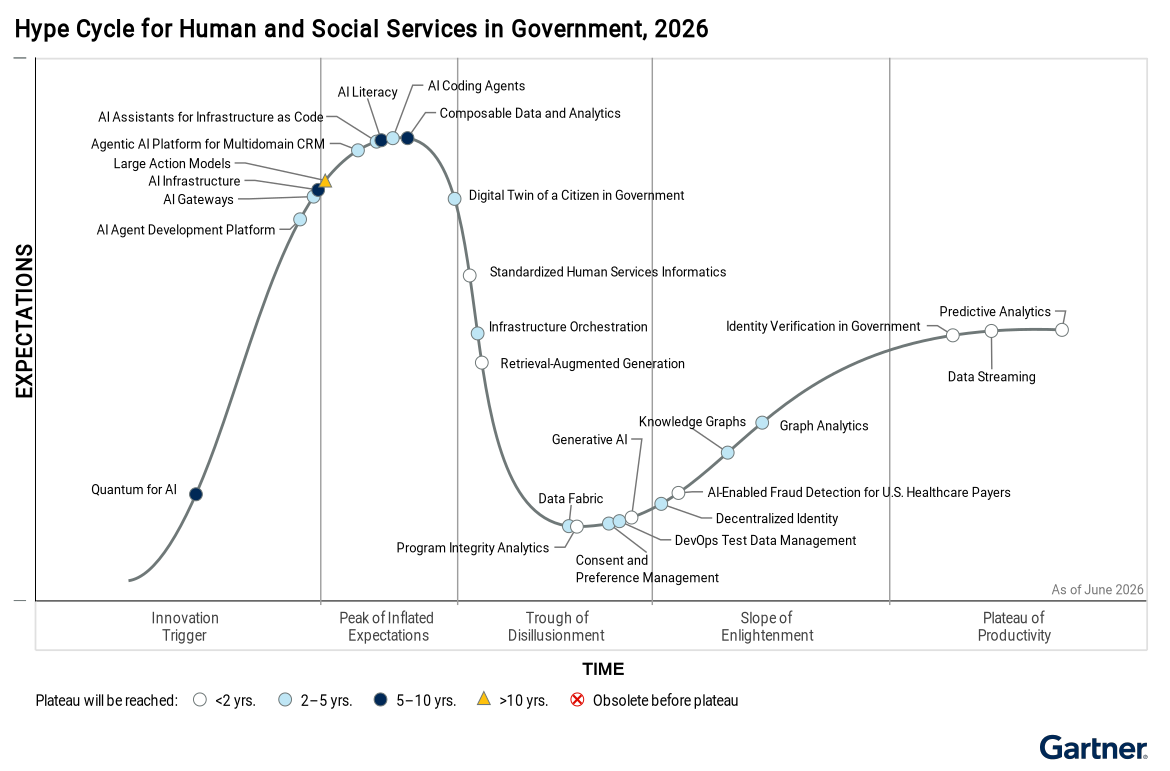
"The Priority Matrix places DevOps Test Data Management in a moderate benefit rating with 2-5 years of mainstream adoption."
The 2026 Hype Cycle examines the transformative influence of AI on government human and social services. This research helps CIOs assess technology investment timing, risks and adoption, and guides strategic decisions for future advancements.
We believe this report describes a highly sensitive environment: legacy systems, personal data, strict regulation, and pressure to modernize. These challenges are very similar to those faced by banking, insurance, healthcare, and telecommunications organizations.
Software delivery velocity has increased through DevOps automation and AI‑assisted development, but test data practices have not kept pace. The traditional approach is increasingly at odds with the requirements for efficiency, quality, privacy and security. Manual refresh cycles, reliance on production data and slow approvals introduce delays that undermine continuous testing. As engineering teams scale automation, access to test data becomes essential to maintain quality and trust.
It helps reduce delays, manual refresh cycles, slow approvals, and the inappropriate use of production data in non-production environments.
According to the report, it is placed in the Slope of Enlightenment phase wherein focused experimentation and solid hard work by an increasingly diverse range of organizations lead to a true understanding of the innovation’s applicability, risks and benefits. Gartner notes a market penetration of 5% to 20% and estimates 2 to 5 years to mainstream adoption.
This is the stage where it becomes clear which approaches deliver real value, and where resolving the concrete friction of test data matters most: consistency across applications, protection of sensitive information, and availability without delays.
As per our understanding, it is a vendor identified by Gartner as an example. It should not be interpreted as a ranking or a recommendation, but as a reference point within the market analysis.
CIOs, CTOs, QA leaders, development teams, architects, security, privacy, and compliance professionals who need to modernize software without compromising quality or data protection.